beginner · stitches · 5 min read
The 5 Crochet Stitches Every Beginner Needs to Know
If you're brand new to crochet, you don't need to learn a hundred stitches before you make something real. Almost every pattern you'll find is built from just five: chain stitch, slip stitch, single crochet, half double crochet, and double crochet. If the abbreviations below look unfamiliar on the page, how to read a crochet pattern decodes the shorthand these stitch names get compressed into.
1. Chain stitch (ch)
The chain stitch is where every project starts. Yarn over, pull through the loop on your hook, repeat. Most patterns begin with "chain 12" or similar — that's your foundation row.
2. Slip stitch (sl st)
The slip stitch is mostly used to join rounds or move your hook across stitches without adding height. Insert your hook, yarn over, and pull through both the stitch and the loop on your hook in one motion.
3. Single crochet (sc)
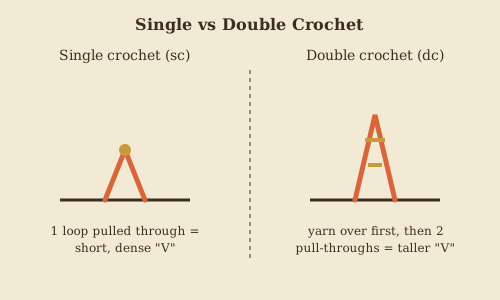
The workhorse stitch, and it breaks down into four small motions. First, insert your hook into the next stitch. Second, yarn over and pull up a loop, which leaves two loops sitting on your hook. Third, yarn over again. Fourth, pull that yarn through both loops at once, leaving just one loop on the hook to start the next stitch. The result is a tight, dense fabric — great for amigurumi and anything that needs structure.
4. Half double crochet (hdc)
This one adds a yarn over at the very start, before the hook even touches the next stitch. Yarn over first, then insert your hook into the next stitch and pull up a loop — you should now have three loops on the hook. Yarn over one more time, then pull through all three loops in a single motion. The finished stitch is a little taller and softer than single crochet — it's the drapey stitch behind the hair bandana pattern.
5. Double crochet (dc)
Start with a yarn over before you insert the hook. Insert your hook into the next stitch and pull up a loop, which puts three loops on the hook. From there, work the loops off in two steps instead of one: yarn over and pull through the first two loops (now two loops remain), then yarn over again and pull through the last two loops to finish the stitch. It's a taller stitch that makes a drapier fabric and works up fast — most blankets and scarves lean on this one. See the full double crochet tutorial for the foundation row and the three mistakes that make dc rows crooked.
Practice project
Grab worsted weight yarn and a 5mm hook, chain 20, and work a few rows of each stitch to feel the difference in height and density before jumping into your first real pattern. Work at least 4 rows of each stitch rather than just one or two — the first row of any new stitch always feels awkward, and the real muscle memory only starts to form by the third or fourth repeat.
What to notice while you practice
Beyond just completing the motion, pay attention to how each stitch actually feels and looks as you build the swatch:
- Height: hold the swatch up and compare how much taller each row of double crochet is than single crochet, worked with the same yarn and hook — the difference is more dramatic than most beginners expect before seeing it side by side.
- Density: try to see light through each section when you hold it up to a window. Single crochet blocks almost all light; double crochet lets noticeably more through, a preview of the warmth difference that matters once you're picking a stitch for a real project.
- Tension consistency: look at the top edge of each row — even, level stitch tops mean consistent tension; a wavy top edge means your grip is tightening or loosening as you go, worth slowing down to correct before it becomes a habit.
A realistic first-week plan
Day one, focus on chain and single crochet only — get one full swatch that looks even before moving on. Day two or three, add slip stitch and half double crochet. By the end of the first week, double crochet on its own swatch, and you're ready for a real first project like the easy dishcloth, which only needs single crochet and half double crochet to complete.
Frequently Asked Questions
Which stitch should I learn first? Chain and single crochet, in that order — every project starts with a chain, and single crochet is the densest, most forgiving stitch to build early muscle memory and tension consistency on before moving to taller stitches.
How long does it take to get comfortable with all five stitches? Most beginners feel reasonably confident with all five after a few practice swatches, roughly 2–4 hours of total hands-on time — though half double and double crochet's extra yarn-over typically take a little longer to feel automatic than chain, slip stitch, or single crochet.
Do I need to learn every stitch before starting my first real project? No — the easy dishcloth and the easy scarf both use only one or two of these five stitches, so a real, finished project is possible well before all five feel comfortable.
Keep going
- 01How to Read a Crochet Pattern (Abbreviations, Symbols, and Gauge Explained)Chain 2, turn, dc in each st across (18) doesn't look like English the first time you see it. Here's every abbreviation, bracket, and asterisk decoded, plus why gauge matters more than any of them.stitches7 min read
- 02How to Crochet a Magic Ring (Step by Step)The magic ring is the invisible start that makes amigurumi circles close completely — no hole in the middle, ever. Ten minutes to learn, and you'll never go back to the chain-2 start.amigurumi7 min read
- 03Corner-to-Corner (C2C) Crochet Tutorial for BeginnersC2C builds a project diagonally, one small block at a time, which is exactly what turns crochet into pixel art. Here's the technique from the very first block to a finished square.stitches5 min read