stitches · beginner · 6 min read
How to Double Crochet: Step-by-Step for Beginners
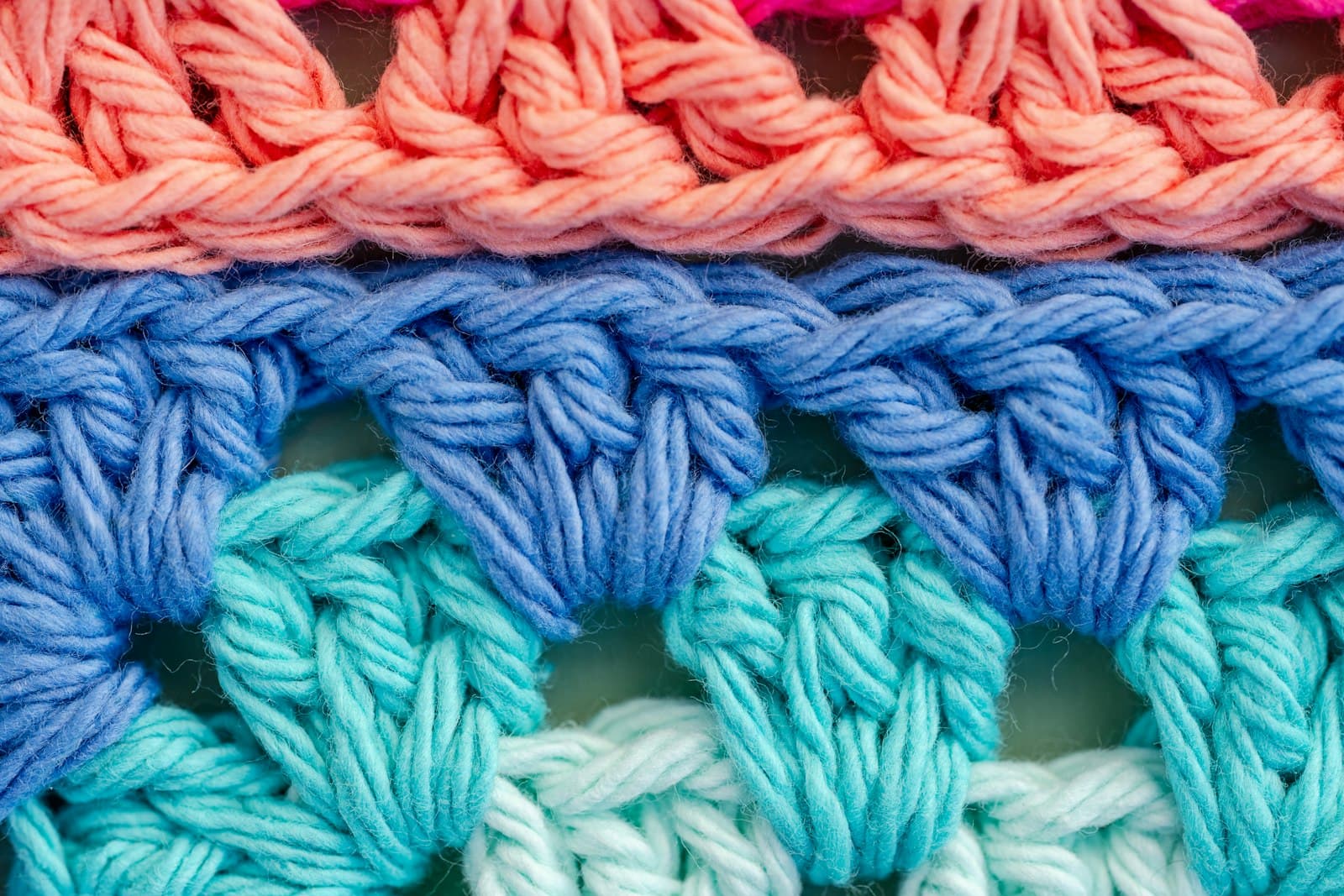
If the 5 basic stitches got you through chain, single crochet, and slip stitch, double crochet (dc) is the next one worth drilling until it's automatic. It's roughly twice the height of a single crochet, works up noticeably faster, and it's the stitch behind most granny squares, most blankets, and a huge share of garment patterns. All instructions here use US terms — see how to read a crochet pattern if "double crochet" and "treble" aren't sorting themselves out yet.
What you need
- Worsted weight (medium, US #4) yarn in any color — the stitch is easiest to see in a light, smooth, non-fuzzy yarn for your first attempt
- A 5.0mm (US H-8) hook
- Nothing else; this is a straight practice swatch, no notions required
Foundation: chain your starting row
Every double crochet row needs a "turning chain" of 3 extra chains, because a double crochet stands taller than a single crochet and needs that height to start the row level. Chain 16 (that's 13 stitches to work into, plus a 3-chain turning chain). Keep the chains relaxed as you make them; a foundation chain pulled too tight will fight you on every stitch of row 1, since there won't be enough give in each loop for the hook to slide through.
Double crochet, step by step
1. Yarn over first. Before you insert the hook anywhere, wrap the yarn over the hook once. This is the detail that separates dc from sc — single crochet skips this step entirely, which is why dc ends up taller. You should see two loops sitting on the hook at this point: the loop already there, and the new wrap.
2. Insert the hook into the stitch. Skip the first 3 chains from your hook (those became your turning chain) and insert the hook into the 4th chain from the hook, under its top loop. The hook should pass through cleanly with a little resistance — if it won't go in at all, you're probably trying to force it through a doubled-up loop instead of the single top strand.
3. Yarn over and pull up a loop. You now have 3 loops sitting on your hook: the original yarn-over from step 1, plus the new loop you just pulled through. Pull this loop up to roughly the same height as the other two so all three sit level, not stacked unevenly.
4. Yarn over and pull through 2 loops. Draw the new yarn-over through only the first two loops on the hook, leaving the third loop untouched for now. This leaves 2 loops on the hook.
5. Yarn over and pull through the last 2 loops. One loop remains on the hook — the stitch is complete. That's one double crochet. A well-formed stitch has a visible "V" at the top and a horizontal bar just below it; if it looks lopsided or twisted, the yarn over in step 4 or 5 likely caught only one strand instead of both.
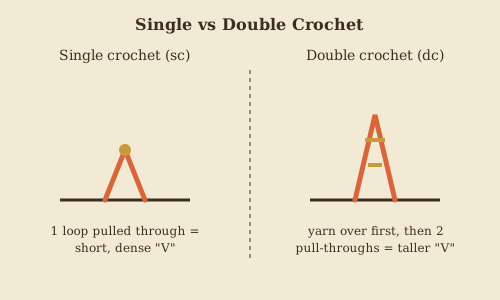
6. Repeat into each remaining chain. Yarn over, insert into the next chain, and repeat steps 1–5 across the row. Count your stitches at the end: 13 double crochets, matching the 13 chains you worked into. If you land on 12 or 14, stop and recount before starting row 2 — it's much faster to fix now than three rows later.
7. Turn and chain 3 to start row 2. The 3 chains stand in for your first double crochet of the new row — skip the first actual stitch and dc into the 2nd stitch across, then continue to the end. Your last dc of the row goes into the top of the previous row's turning chain, not into thin air past it. That final stitch can be easy to miss because the turning chain doesn't look like a "real" stitch; look for the two loops sitting at the top of the chain and treat it exactly like any other stitch.
The rhythm, once it clicks
Double crochet has a "yarn over, in, yarn over, pull through two, pull through two" rhythm that's genuinely faster to work than single crochet's shorter motion, because there's less friction pulling the hook back through a tight stitch each time. Most crocheters find their dc rows outpace their sc rows within the first swatch or two.
Three mistakes that make rows crooked
Forgetting the first yarn-over. If a row suddenly looks like single crochet again, you skipped step 1 on one or more stitches. Every dc starts with yarn over, no exceptions.
Miscounting the turning chain as a stitch — or not. The 3-chain turning chain counts as your first dc only if the pattern says so (most do, for dc). If you skip your first real stitch to account for it but the pattern doesn't count the chain as a stitch, you'll lose one stitch every single row, and your rectangle will slowly turn into a triangle. Check the pattern's gauge/stitch-count notes for "ch 3 counts as first dc" — if it's not stated, assume it does for standard dc rows.
Missing the last stitch. The final dc of every row goes into the top of the previous row's turning chain — it's easy to see the end of the row and stop one stitch early. If your rectangle is narrowing from one side only, this is almost always why. Count your stitches after every row until it's automatic: it should match the row before it, every time.
Once double crochet is reliable, the granny square blanket pattern is built almost entirely from it — a natural next project to put the stitch to work. For something smaller and faster, the dog bandana pattern uses this exact stitch worked corner-to-corner into a triangle.
Frequently Asked Questions
Why does my double crochet fabric look holey or full of gaps? Some visible openness is normal for double crochet — it's a taller, less dense stitch than single crochet by design. If the gaps look larger than the rest of your fabric, check that you're inserting the hook under both loops of each stitch, not just the front loop, which can leave stitches loosely anchored.
How do I double crochet into a chain without it twisting? Lay your foundation chain flat on the table before you start, with the front "V" of each chain facing up, and insert your hook under just the top loop (or both top loops for a sturdier edge) consistently down the whole chain — consistency in which loop you use matters more than which specific loop you choose.
Is double crochet harder to learn than single crochet? Not harder, just one more motion — the extra initial yarn-over is the only new step, and most crocheters who are comfortable with single crochet pick up double crochet within a single practice swatch.
Keep going
- 01How to Read a Crochet Pattern (Abbreviations, Symbols, and Gauge Explained)Chain 2, turn, dc in each st across (18) doesn't look like English the first time you see it. Here's every abbreviation, bracket, and asterisk decoded, plus why gauge matters more than any of them.stitches7 min read
- 02How to Crochet a Magic Ring (Step by Step)The magic ring is the invisible start that makes amigurumi circles close completely — no hole in the middle, ever. Ten minutes to learn, and you'll never go back to the chain-2 start.amigurumi7 min read
- 03Corner-to-Corner (C2C) Crochet Tutorial for BeginnersC2C builds a project diagonally, one small block at a time, which is exactly what turns crochet into pixel art. Here's the technique from the very first block to a finished square.stitches5 min read