stitches · beginner · 5 min read
Corner-to-Corner (C2C) Crochet Tutorial for Beginners
Corner-to-corner (already used for the diagonal triangle shaping in the dog bandana pattern on this site) works differently from every stitch on the 5 stitches guide: instead of straight rows across a fixed width, you build a project as a diagonal grid of small "blocks," each one 3 double crochets wide. That block-grid structure is exactly what makes C2C the technique behind pixel-graph blankets — each block is one pixel, and swapping colors block-by-block draws a picture.
Abbreviations
- ch — chain
- dc — double crochet
- sl st — slip stitch
- st(s) — stitch(es)
Materials
- Worsted weight yarn (US #4), any colors — a single color to learn the technique, multiple colors once you're ready to graph a design
- 5.0mm (US H-8) hook
- Yarn needle
The first block
Block 1. Chain 6. The first 3 chains act as a turning-chain "tail" and don't get worked into; skip past them by starting your first dc in the 4th chain from the hook. From that stitch, dc in each of the next 2 chains as well, for 3 dc total. You've now made one 3-dc block, anchored by its own 3-chain tail. This single block is the entire foundation — everything else in C2C is just adding more blocks around this one.
Increasing: growing the diagonal
Each new row adds exactly one block to the growing edge and one block to the corner where the new row starts:
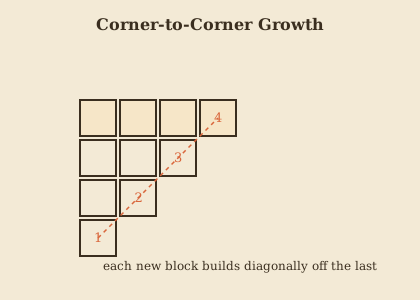
Starting a new row. Chain 6, turn. Dc in the 4th chain from hook, dc in next 2 chains — this is a brand new block, unconnected to anything yet.
Joining to the previous row. Slip stitch into the top chain-space of the very next block from the previous row. Chain 3, then dc, dc, dc into that same space — this adds a second block on the current row, now connected to the growing diagonal.
Continuing across the row. Repeat "slip stitch into the next block's space, chain 3, dc 3 into that space" once for every existing block from the previous row, working your way across. Each full row you complete has exactly one more block than the row before it.
Repeat this — chain 6 and turn to start a new row, work a fresh corner block, then join across through every existing block — until your diagonal grid reaches the width you want.
Decreasing: closing the other half
Once the piece is as wide as you want it (usually when it's roughly square, block-count equal to block-count), switch to decreasing one block per row instead of adding one:
Decrease row. Instead of starting with a fresh chain-6 corner block, slip stitch across the first block's 3 stitches and then into its joining chain space, moving your working loop past that entire block without adding any new stitches to it. From that new position, continue across the row exactly as before: chain 3, then dc 3 into each following block's space, repeating across. Because you skipped working a new corner block, the row ends up with one fewer block than the row before it.
Repeat the decrease row until you're back down to a single block, then fasten off — you now have a square (or rectangle, if you decrease from a different row count than you increased to) built entirely from diagonal blocks.
Reading a C2C graph for colorwork
A C2C graph looks like a pixelated image, one colored square per block. Work the piece exactly as above, but change colors (see how to change colors in crochet) at the start of whichever block the graph calls for a different color, cutting and rejoining yarn as needed rather than carrying a color across blocks it isn't used in.
Common early mistakes
Losing track of which row you're on. C2C rows are easy to miscount because they don't look like traditional rows. Count blocks, not rows, and cross-check against your target block count regularly.
Uneven tension between blocks. Because every block starts with its own chain-3 or chain-6, tension differences between blocks show up as a wavy rather than straight diagonal edge. Keep the starting chains snug and consistent, the same discipline the mistake-fixing guide recommends for any repeated foundation chain.
Frequently Asked Questions
How do I know how many blocks I need for a specific finished size? Measure or swatch a single block (roughly 1–1.5 inches per block at worsted weight with a 5mm hook), then divide your target width and height by that measurement to get the block counts for increasing and decreasing.
Can C2C be worked in single crochet instead of double? Not in the traditional sense — the technique specifically relies on double crochet's height to build 3-stitch blocks efficiently. A single crochet version would need far more stitches per block to reach a comparable size, losing most of the speed advantage C2C is known for.
Is C2C harder than a regular granny square blanket? Not harder, just different — C2C has no seaming between squares since it's one continuous diagonal piece, but it does require more careful row-counting than a granny square's simpler round-based structure like the granny square blanket uses.
Keep going
- 01How to Read a Crochet Pattern (Abbreviations, Symbols, and Gauge Explained)Chain 2, turn, dc in each st across (18) doesn't look like English the first time you see it. Here's every abbreviation, bracket, and asterisk decoded, plus why gauge matters more than any of them.stitches7 min read
- 02How to Crochet a Magic Ring (Step by Step)The magic ring is the invisible start that makes amigurumi circles close completely — no hole in the middle, ever. Ten minutes to learn, and you'll never go back to the chain-2 start.amigurumi7 min read
- 03How to Crochet a Flat Circle (Without It Curling or Ruffling)Every flat circle follows the same increase math — 6 more stitches every round. Here's the formula, plus the two exact fixes for a cupping circle and a ruffling one.stitches5 min read