stitches · beginner · 5 min read
How to Crochet a Flat Circle (Without It Curling or Ruffling)
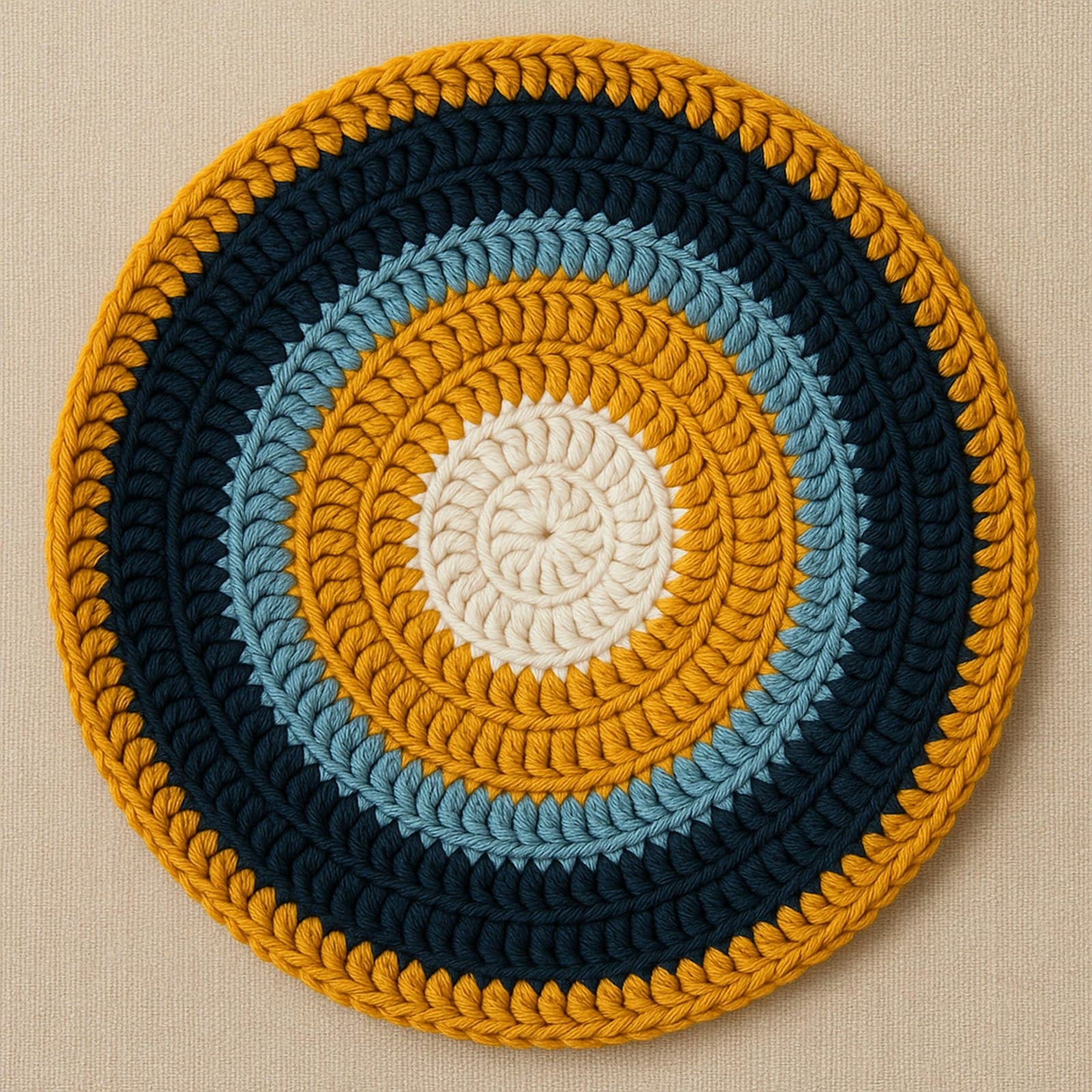
A coaster, a granny circle, an amigurumi base, a rug — every flat crochet circle uses the exact same increase formula underneath, whatever the finished object looks like. Once the pattern of "add 6 stitches, spread a little further apart, every round" is in your hands, you can build a flat circle to any size without following anyone else's row-by-row instructions.
Abbreviations
- sc — single crochet
- inc — increase (2 sc in same stitch)
- st(s) — stitch(es)
The formula
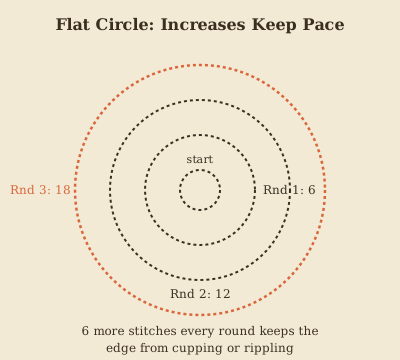
Start with a magic ring (see the magic ring tutorial if that start is new) and 6 single crochet worked into it, then pull the ring's tail snug so no hole remains at the center — you should be able to hold the little disc up and see it sit flat, not cupped, right from round 1. Every round after that adds exactly 6 more stitches than the round before, but spreads those 6 increases evenly around the round instead of clustering them:
| Round | Instruction | Stitch count |
|---|---|---|
| 1 | 6 sc into magic ring | 6 |
| 2 | inc around (2 sc in every st) | 12 |
| 3 | sc, inc around | 18 |
| 4 | sc 2, inc around | 24 |
| 5 | sc 3, inc around | 30 |
| 6 | sc 4, inc around | 36 |
| 7 | sc 5, inc around | 42 |
The pattern: on round n, work (n-1) plain single crochets between each increase. Continue this pattern for as many rounds as your circle needs — a coaster stops around round 5, a placemat keeps going for 15 or more.
Why 6 stitches specifically
Six is the number that keeps a single-crochet circle's circumference growing at the same rate its radius grows — single crochet stitches are roughly as tall as they are wide, and 6 evenly-spaced increases per round matches that proportion. Double crochet and half double crochet circles, being taller stitches, typically need a different count (commonly 8 or 12 per round) to stay flat — the exact number always comes down to matching your increase rate to your stitch's actual height-to-width ratio.
Troubleshooting: it's curling into a bowl
The cause: not enough increases for the round you're on — the outer edge is physically too short to lie flat against the growing inner rounds, so it pulls upward into a cup shape.
The fix: frog back to where the curling started and re-check your stitch count against the table above. If you're consistently landing short, add an extra increase round, or increase more frequently for a round or two to "catch up," then resume the standard formula. After the catch-up round, lay the piece flat again: the edge should relax down onto the table instead of springing back up into a cup shape.
Troubleshooting: it's rippling or ruffling at the edge
The cause: the opposite problem — too many increases for the round, so there's more fabric than the circle needs and it has nowhere to go but wave.
The fix: skip a full increase round. If you were on track to do sc 4, inc around, instead work one plain round of sc with no increases at all, then resume the formula on the following round as if that plain round had been the increase round it replaced. This removes exactly one round's worth of increases without you having to rip anything out. Check the edge again after the plain round: it should stop waving and settle flat, with only a gentle, even curve at the outer rim.
Checking as you go
Lay the circle flat on a table every 2–3 rounds rather than waiting until it's finished to notice a problem. Press it gently flat with your palm: a healthy circle stays down with light pressure, while a circle that's starting to cup will spring back up as soon as you let go, and one that's starting to ruffle will show visible waves along the outer edge even under your hand. A circle caught curling at round 4 is a 30-second fix; the same problem discovered at round 12 means frogging eight rounds of work.
Once a flat circle is reliable, the coaster set and the mug cozy both put this exact formula to work at two different final sizes.
Frequently Asked Questions
Does the 6-stitch increase rule work for every yarn weight? Yes — the formula is about stitch proportions, not yarn weight, so it holds whether you're working with fine thread or bulky yarn. What changes with yarn weight is only the physical size of each round, not the increase count.
Why does my double crochet circle need more than 6 increases per round? Double crochet stitches are taller relative to their width than single crochet, so matching that different proportion usually takes 12 increases per round instead of 6. Half double crochet typically lands in between, often at 8 or 9.
Can I use this formula to make an oval instead of a circle? Not directly — an oval needs a different approach (a flat foundation chain with increases concentrated at the two rounded ends only, the technique used in the market tote bag's base), rather than evenly-spaced increases all the way around.
Keep going
- 01How to Read a Crochet Pattern (Abbreviations, Symbols, and Gauge Explained)Chain 2, turn, dc in each st across (18) doesn't look like English the first time you see it. Here's every abbreviation, bracket, and asterisk decoded, plus why gauge matters more than any of them.stitches7 min read
- 02How to Crochet a Magic Ring (Step by Step)The magic ring is the invisible start that makes amigurumi circles close completely — no hole in the middle, ever. Ten minutes to learn, and you'll never go back to the chain-2 start.amigurumi7 min read
- 03Corner-to-Corner (C2C) Crochet Tutorial for BeginnersC2C builds a project diagonally, one small block at a time, which is exactly what turns crochet into pixel art. Here's the technique from the very first block to a finished square.stitches5 min read