stitches · tips · 7 min read
How to Bobble Stitch and Puff Stitch (The Two Textured Stitches Everyone's Using)
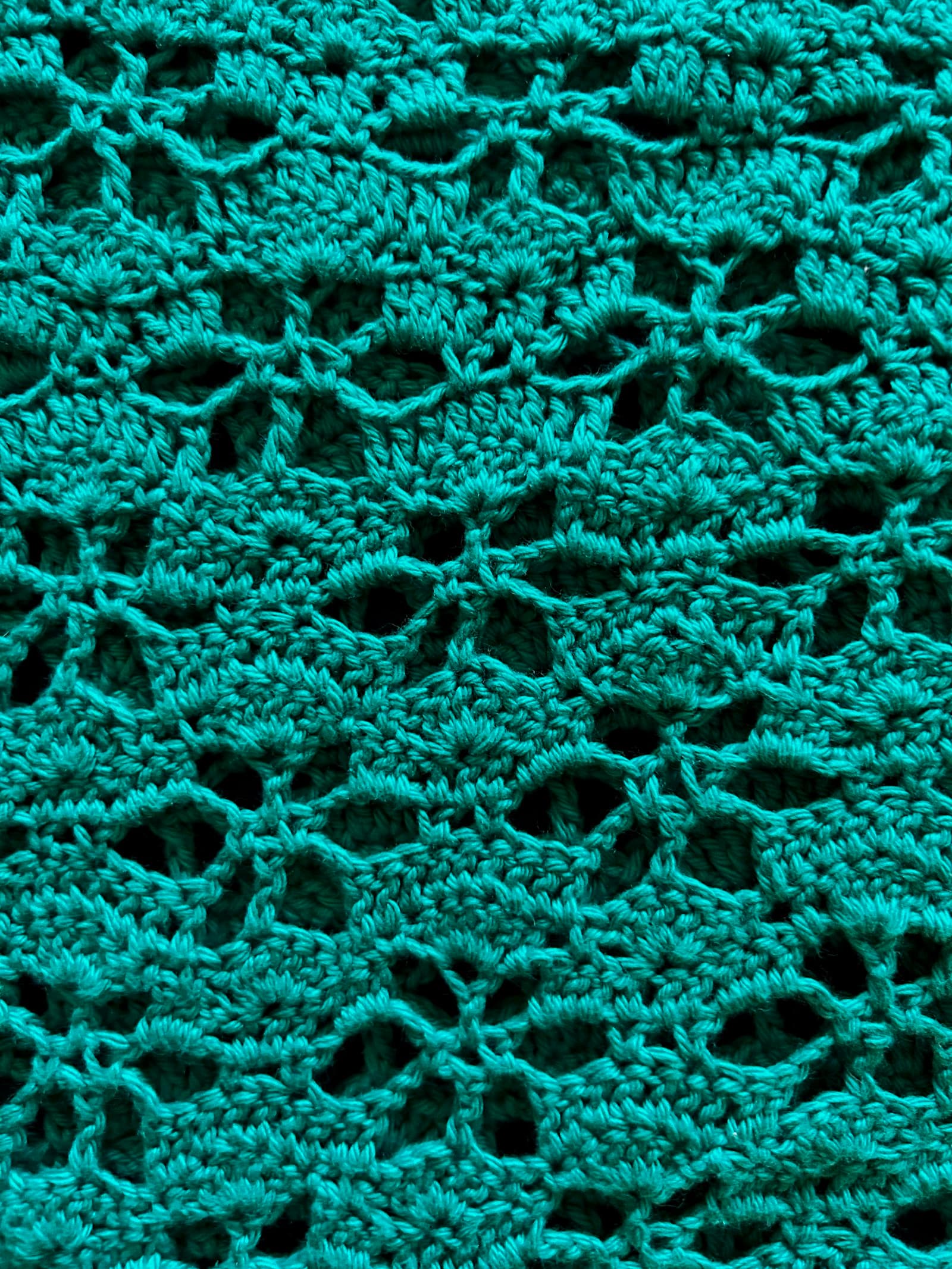
Textured crochet is everywhere right now — waffle stitch, alpine stitch, basket weave — and bobble and puff are the two stitches underneath most of it. They both make a raised bump stand up out of otherwise flat fabric, they're both worked by building up several loops on the hook before closing them together, and they're both routinely confused for each other in pattern write-ups that just say "make a bobble" without saying which construction they mean. They're not interchangeable: a bobble is firm and has visible angles, a puff is soft and rounded. Once you've made both in the same swatch, you'll never mix them up again.
Abbreviations
- ch — chain
- sc — single crochet
- dc — double crochet
- yo — yarn over
- st — stitch
Puff stitch, step by step
A puff stitch is built from loose, untensioned loops, which is what gives it a soft, rounded profile.
- Yarn over, insert your hook into the stitch, yarn over, pull up a loop — keep this loop tall and loose rather than snugging it down. It should stand up roughly as tall as an unfinished double crochet loop; if it's flattened against your hook, it's too tight. You now have 3 loops on your hook (the original loop plus this new pair).
- Repeat step 1 three more times into the same stitch — yarn over, insert, yarn over, pull up a loop, without closing anything in between. Each repeat adds 2 more loops, and the hook will start to feel crowded as the loops stack up; that's expected. After 4 total repeats, you'll have 9 loops on your hook, all roughly the same height.
- Yarn over one final time and pull through all 9 loops at once. This pull-through takes more effort than a normal stitch since you're drawing yarn through nine loops together — go slowly and keep the loops from twisting as you pull, or the puff will sit crooked.
- Chain 1 to close and lock the puff in place — this small chain sits right on top of the stitch and keeps the puff from unraveling back out. You should see a soft, rounded bump sitting proud of the fabric once this chain is in place; if it looks flat, the loops in step 1 weren't kept loose enough.
That closing chain-1 is the detail most missed-puff-stitch problems trace back to: skip it, and the loose loops that give the puff its softness can work themselves loose over time.
Bobble stitch, step by step
A bobble (sometimes called a cluster) is built from partially-worked double crochets, which is what gives it a firmer, more faceted look than a puff.
- Yarn over, insert your hook into the stitch, yarn over, pull up a loop (3 loops on hook), yarn over, pull through 2 loops only — this is a normal double crochet stopped one step early, leaving 2 loops on your hook instead of finishing down to 1. Watch the loop count on your hook, not the motion: if you're back down to 1 loop, you pulled through too far and completed a full double crochet by mistake.
- Repeat step 1 four more times into the same stitch, each time stopping with 2 loops added and never pulling all the way through. After 5 total repeats, you have 6 loops on your hook (5 pairs plus the original), and you should be able to see five distinct unfinished double-crochet "legs" fanned out from the same base stitch.
- Yarn over and pull through all 6 loops at once to close the cluster. This pull-through is snugger and more resistant than a normal stitch; pull steadily rather than yanking, so the cluster closes into a tidy, even bump rather than a lumpy one.
Because each of those partial stitches has real height and a defined double-crochet shape, the closed bobble holds sharper angles than a puff's soft dome — that structural difference is the whole reason the two exist as separate stitches rather than one.
A swatch that shows you the difference
Instructions alone don't make the difference click the way feeling it in your own hands does. Chain 20, then:
- Row 1: sc in the 2nd chain from hook and each chain across (19 sts). Check that the row lies flat with no ripple before moving on; a curled row here means your foundation chain was too tight.
- Row 2: ch 1, turn. Sc 3, work a puff stitch (as above), sc 3, work a bobble stitch (as above) repeat across, ending with sc to fill any remaining stitches. As you go, each puff and bobble should sit noticeably higher than the plain sc stitches around it; if a bump is flush with the surrounding fabric, it isn't fully closed.
Working both stitches in the same row, a few stitches apart, on the same piece of fabric is the fastest way to feel the difference: run a finger over each bump, and the puff will give slightly and feel rounded, while the bobble will feel firmer with a distinct edge where the double crochets meet.
Common problems and fixes
- Bobble/puff is barely visible, flush with the fabric: you're likely working the surrounding rows too loosely, or the stitch itself too tightly — a bobble or puff needs the rows around it snug enough that the bump has something firm to push against and stand proud of.
- The stitch looks lopsided, leaning to one side: the loops weren't kept even in height while building them up — every yarn-over-pull-up-a-loop repeat should reach roughly the same height before you move to the next one.
- Holes appear on the wrong side behind each bobble/puff: this is normal and expected — both stitches naturally pull the base of the stitch slightly, and it's why textured-stitch patterns are almost always worked with the bump facing the right side (the side that shows).
Where to use each one
Puff stitches suit anything meant to feel soft against skin — baby blankets, amigurumi accents, a textured cowl. Bobbles hold their shape better under tension, which makes them the better choice for anything structural or frequently handled — bag flaps, coaster edges, a textured swatch meant to lie flat rather than drape.
Frequently Asked Questions
Is a bobble stitch the same as a popcorn stitch? Not quite, though they're closely related and often confused. A popcorn stitch is worked as a group of complete double crochets (not partial ones) into the same stitch, then the hook is removed and re-inserted through the first and last stitch of the group to fold it into a more pronounced, sharply popped bump — an extra step the bobble above skips, which is why bobbles are flatter and easier for a first attempt.
Why does my puff stitch keep unraveling? Almost always a skipped or too-loose closing chain — that chain-1 after pulling through all the loops isn't optional trim, it's the stitch that anchors the puff's loose loops in place. If it keeps working loose anyway, try tensioning the very last loop before the chain slightly tighter than the rest.
Can I substitute a puff stitch for a bobble stitch in a pattern? You can, but the fabric will behave differently than the designer intended — a puff-substituted piece will drape softer and use very slightly less yarn per stitch, while a bobble-substituted piece will stand up firmer and hold its texture under handling. For anything where the finished feel matters (a garment vs. a coaster), swatch both first rather than assuming they're interchangeable.
Ready to put texture to work in an actual project? The granny square blanket is worked entirely in regular double crochet, but swapping every fourth cluster for a bobble is a natural way to try this out on something you'll actually use.
Keep going
- 01Single Crochet vs Double Crochet: Which Should You Use?Same yarn, same hook, two completely different fabrics — one dense and warm, one tall and drapey. Here's how to actually decide between them for a specific project, not just what each stitch is.tips5 min read
- 02How to Change Colors in Crochet (Invisible Join, No Jog)The visible 'staircase' at a color change isn't inevitable — it's caused by finishing the last stitch in the old color instead of the new one. Here's the one-step fix, plus how to hide the join in rounds.stitches5 min read
- 03How to Read a Crochet Pattern (Abbreviations, Symbols, and Gauge Explained)Chain 2, turn, dc in each st across (18) doesn't look like English the first time you see it. Here's every abbreviation, bracket, and asterisk decoded, plus why gauge matters more than any of them.stitches7 min read